
What I learned about Heat Acclimation Training

As I prepped for the Xterra trail 21k worlds, I did a little research on how to prepare for the heat and humidity while training in the winter temps of the Pacific Northwest. Here’s what I learned:
Heat training works
When we are fully acclimated to a hot environment, our running performance can increase between 5-8%. (Lorenzo, et al). Our body undergoes tons of groovy changes to help us manage running in the heat, including:
- Increased blood plasma volume
- Higher sweat rate
- Earlier sweat rate (sweating begins at a lower core body temperature)
- More dilute sweat (sweat glands adapt to help you conserve some of the salts you lose with sweat)
Together, these adaptations result in a reduced heart rate and lower core body temperature at a given exercise intensity and environmental temperature (Minette, et al).
Anyone can Heat Train
It takes less time than I expected! Most of the research suggests one should aim for 7-14 consecutive days of heat exposure. Ideally, it should raise core body temperature to 101.5 degrees F for between 50-100 minutes each day. 75% of the adaptations will happen in the first 4-6 days (Pandolf, et al).
To get the most out of heat training:
- Try to simulate the temperature and humidity of the environment you’re training for as closely as you can.
- Use a combination of active exposure (easy/moderate running while hot) and passive (sitting in a sauna) to get your 100 minutes / day. The body doesn’t technically know the difference, but there are differences: Active exposure may cause faster adaptations, but it is also more exhausting and may limit your training gains. Passive exposure is slower but won’t tire your legs. The experts agree a mixture of both may be the best of both worlds.
- Keep your harder workouts at cooler temperatures to avoid detracting from the training stimulus. Try to add heat in a way that gets your core body temperature up but doesn’t overly fatigue your legs.
- Some of the adaptations, like your sweat pores changing, only happen locally. This means that if part of your body, like your face, is uncovered or not warm, it will not adapt fully.
- Don’t heat train right up to the day of the race, as it may compromise recovery.
Use it or Lose it
The research is mixed, but generally it seems that you lose one day of heat training for every 2-5 days away from heat (Daanen, et al). Experts recommend starting your heat training 2-3 weeks prior to a race, then do 1 heat day every 2-3 days during the taper to maintain the benefit. Living in a cooler house will not detract from the effect of your heat training.
Huge thanks to Evan Williams for his great blog post on heat training which guided me to a lot of this info. He cites this article by irunfar which goes into even greater detail. Also, this podcast by Science of Ultra was very helpful.
Here's what I did
I was a little late to the game so I didn’t start my heat training until 2 weeks before race day. It was far from perfect but so fun! It made me feel like I was getting more out of my training. The heat definitely made the running much harder, and I would wake up the next morning more tired than usual. My favorite workout was an 11 mile course simulation on the treadmill. I adjusted the incline to match the timing and pitch of each hill on the course. It was brutal. My body was on fire, I had to use every mental trick I knew to keep going, and my soaked cotton clothes weighed a nasty 7lbs by the time I was done. But on race day, the familiarity with feeling hot and the timing of the hills was helpful.
I ended up with 9 days of heat workouts. I chose to skip a few days to not compromise my workout or just because I needed a rest day and didn't feel like turning my room into a sauna.

What worked well for me was using the treadmill in the gym, and adding 2-3 extra layers top and bottom, (running tights, hiking pants, ski socks, long sleeve running top, heavy running jacket or sweatshirt, gloves, buff around my neck, hat). It would have been even more effective to add a non-breathable shell and face mask to increase the coverage and humidity, but I was too self-conscious to dress that way in my gym.
On days when I ran outside, I had to wear a LOT more clothes to get my body temperature up. I did not use a thermometer, I just guessed based on sweat rate and how uncomfortable I felt. When running outside, I found that I had to wear as many layers as I would if I were resort skiing (baselayer bottom and top, waterproof pants, fleece jacket, rain jacket, gloves, hat, neck buff). Evan's trick was to subtract the difference between your race temperature and the actual temperature, from the actual temperature, and dress as if that was the current thermometer reading. For me, it was usually around 50 degrees F, I needed it to feel like 84, so that meant I should dress as if it was 84-50= 26 degrees F outside.
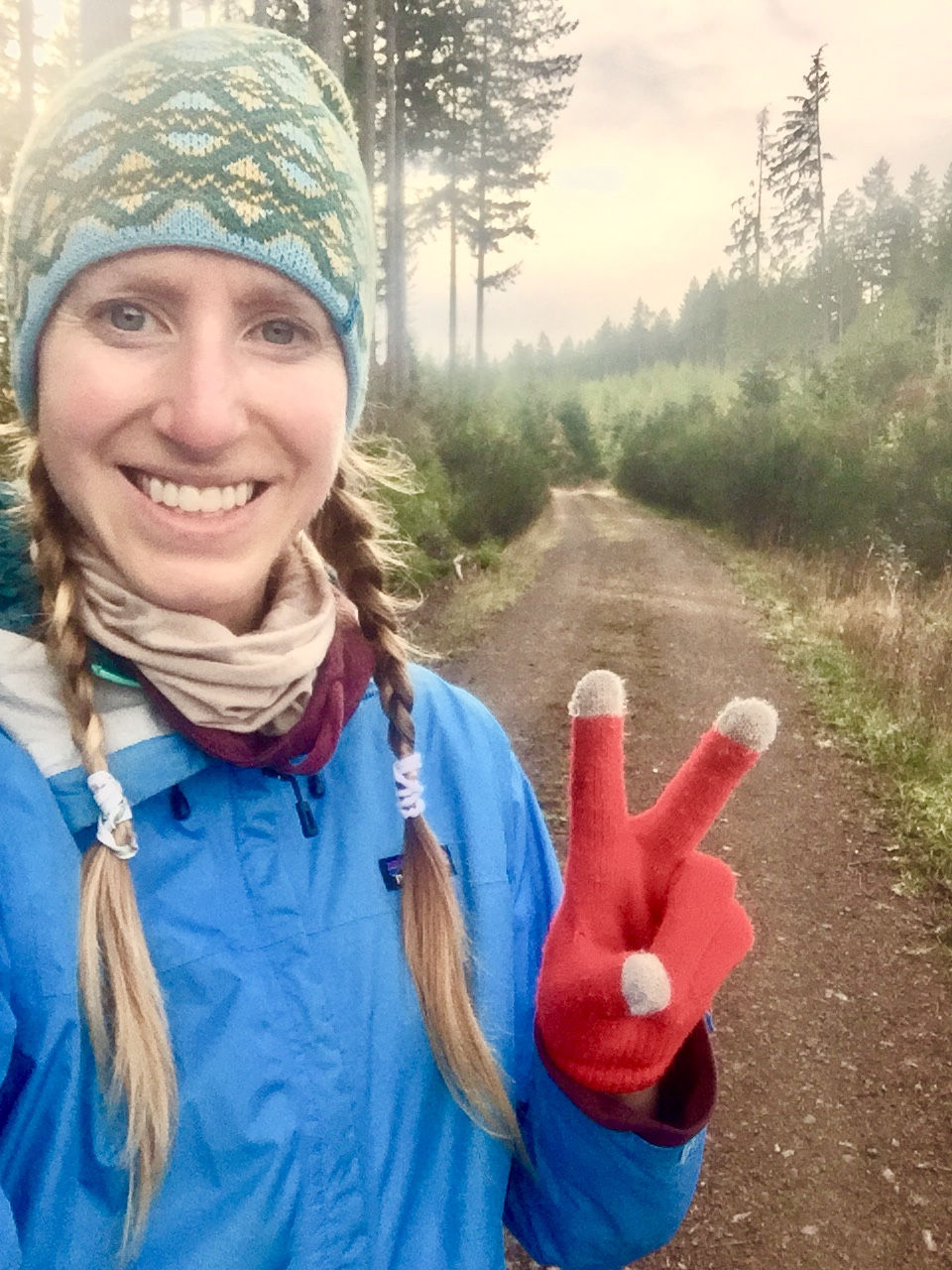
To add passive heating time to my outdoor runs, I would leave all my clothes on and crank the heat up in the car and take the long way home.
A few tips:
- Plan time to do a lot of extra laundry. By the last few days I was very low on running-appropriate warm layers:

- Pay attention to hydration. Even when fully acclimated, research has shown that you need to drink the same or more water.
- Do not practice running dehydrated. Water is not like carbs...your body does not 'get better' at running dehydrated, if anything it will impair your training (Sawka, et al).
- It’s okay to overdo the heat. Researchers have found a 2-5% increase in performance, even in cool weather, after heat training.
I am working on a full race recap for Xterra Trail worlds right now. I think the heat training really helped me handle the humid, 84 degree weather of O'ahu. I am super happy with how the race went! Stay tuned.

Good luck and happy running!
Daanen, H. A., Racinais, S., & Périard, J. D. (2017). Heat Acclimation Decay and Re-Induction: A Systematic Review and Meta-Analysis. Sports Medicine,48(2), 409-430. doi:10.1007/s40279-017-0808-x
Lorenzo, S., Halliwill, J. R., Sawka, M. N., & Minson, C. T. (2010). Heat acclimation improves exercise performance. Journal of Applied Physiology,109(4), 1140-1147. doi:10.1152/japplphysiol.00495.2010
Minett, G. M., Skein, M., Bieuzen, F., Stewart, I. B., Borg, D. N., Bach, A. J., & Costello, J. T. (2016). Heat acclimation for protection from exertional heat stress. Cochrane Database of Systematic Reviews. doi:10.1002/14651858.cd012016
Pandolf, K. (1998). Time Course of Heat Acclimation and its Decay. International Journal of Sports Medicine,19(S 2). doi:10.1055/s-2007-971985
Sawka, M. N., Leon, L. R., Montain, S. J., & Sonna, L. A. (2011). Integrated Physiological Mechanisms of Exercise Performance, Adaptation, and Maladaptation to Heat Stress. Comprehensive Physiology,1883-1928. doi:10.1002/cphy.c100082


Comments