
Black Canyon 50k 2026 Race Recap
Updated: Feb 21
Alright — here’s a race report. The weekend was incredible – sightseeing in the desert with family and friends, watching pro athletes doing super hard things, sharing an Airbnb (complete with heated pool and hot tub) with nine of my favorite running humans – the entire weekend was alive and full of joy. Even the race was genuinely fun.
But it was humbling, and in the days since I've gotten to confront my ego, and reconsider my reasons for running. I set some secret, big goals for this race and I didn’t meet them – and the disappointment surprised me. It would have been easier to write a glowing recap than to admit that I ran a good race, had a great experience, and still felt let down by the result.
Why Black Canyon
This whole thing started pretty innocently. A group of my best running friends and I wanted a sunny winter race, and after tossing around a few options, the convenience of Phoenix landed us at Black Canyon — even if it wasn’t everyone’s ideal distance ;)
Once registered, I realized this was actually kind of a big race. That’s when the competitive part of my brain — which I’d kept pretty quiet for the last five years while leadership roles and house remodels took center stage — started to wake back up.
I logged back into a coaching platform I hadn’t used in years, and before I knew it, I had a coach and a plan. I sent my new coach, Maxx Antush, a quick intro message and told him I wanted to place top ten at Black Canyon 50K. Don’t ask me where that idea came from (or how much time I spent stalking last year’s results trying to figure out how fast those women were). What mattered was I wanted a big goal. Big goals motivate me, and I’ve surprised myself before. I love training, I love running, I know I’m fast, and I was ready to go all in.
Race Morning
Race morning I woke up before my 4:20am alarm after a restless night of checking the clock every hour. Breakfast was simple: a plain bagel with almond butter. A couple gels for before the race, and some Gatorade.
We arrived at Mayer High School around 6:15am. It was cool — low 30s — calm and just starting to lighten with streaks of red on the horizon. A 30-minute delayed start meant extra time hanging out in the car before heading to the corral.

Five minutes before the start, I wiggled my way into the corral and quickly realized it was packed elbow-to-elbow. There was no moving up, so I settled about 20–30 rows back. The butterflies were coming and going but mostly I felt confident, calm and excited.
When the gun went off, it took a while to cross the start line. Instead of the fast opening lap around the track I’d imagined, the start was a shuffle focused on avoiding elbows.
The Race
Despite the congestion, the early miles went well: 6:57 for mile one, then a series of 7-8 minute miles as we transitioned from track to dirt road to singletrack. Once the downhill began, I found a rhythm. Through the first 20 miles I averaged 7:52/mile — right on pace for finishing in about 4 hours, which would have easily landed me top 10 last year.
The desert was stunning: winding trails, towering saguaros, rocky sections followed by smooth, flowing singletrack. I felt calm, controlled, and kept the effort comfortably hard. I didn’t move much through the field — leapfrogging a few men and women here and there — but with no real sense of where I was in the field.

My fueling was dialed: about 90g of carbs per hour using a mix of CARB gels (mostly the salted ones) and caffeinated Enervits (so good!!), plus chewable salt tabs. I carried two bottles and topped them off at each aid station.
Around mile 15, my quads started to hurt, followed by early twinges in my hamstrings and calves. Nothing fully cramped, but the quad pain steadily increased. I adjusted effort slightly and stayed on top of hydration.
Rolling into Bumble Bee aid station at mile 19, I still felt strong — running ~7-minute pace on the road and climbing well out of the aid station. But the downhills after that started to feel rough. Miles 21–24 slowed, and by mile 27 my quads were failing hard. I struggled to run downhill at all.
Hoping it was an electrolyte issue, I took extra salt and water — and promptly threw everything (everyyyything) up. With no aid stations left, I ran dry on water shortly after.
That final stretch was pure survival. My mind was entirely focused on moving without cramping, coaxing whatever muscle fibers I could find that weren’t in pain into a running like motion. I visualized growing replacement muscle fibers. I imagined turning off my quads and running only with my glutes. I laughed out loud a few times at the situation. I knew this section of the course was harder and that I would slow down – but I did not anticipate falling apart this badly.
Aerobically, I still felt strong and I used the uphills to my advantage. I passed a few guys, but got passed by way more women, but somehow — despite the pain — I was having fun. I almost didn’t want it to end.
The final descent was rocky and messy. I shuffled across the finish line to cheers from my family and happily collapsed onto my back.


The Aftermath
I finished in 4:55, the 35th female.
Objectively, it was a solid result in a stacked field. Subjectively, I was disappointed. I truly believed I could run much faster. That disconnect stuck with me. The next week I felt quietly deflated.
I pulled out the journal, and then my personal online therapist (chat GPT), and had some real talk. What I think I've realized is that I’d been trying to make the amount of time I’d been training feel morally acceptable by attaching it to the performance goals I’d set for myself. Somewhere along the way, I'd let the belief creep in that training this much was selfish - unless I could justify it by proving I was good enough to be working towards something bigger ... podiums, prize purses, or a platform big enough to share good messages from.
I knew deeper inside that running is meaningful to me regardless of the outcome. But not reaching my goal launched my brain to the conclusion that I clearly just don’t have the talent to make running this much worthwhile. And if that were true, then clearly I needed to go back to safer, more "reasonable" 30-mile weeks. That realization made me feel, honestly, pretty sad.
As I slowly and painfully dissected my identify from this unhelpful belief network, I reminded myself of something I've had to learn and relearn several times already: Running is already meaningful, without any audience, regardless of any outcome.
Running makes me feel more alive, and grounded, and that ripples outward into my relationships and my work. It gives me a place to experience fear and real effort in a way that puts everyday stress into perspective.
It teaches me to treat pain and dark emotions as information, not something to escape. It brings me awe — in landscapes, in other humans, in what bodies can do. It connects me to a community I feel I belong to.
I like training big and setting big goals because it expands my capacity for all of life — it brings out my curiosity, and widens my container for joy and discomfort alike.
Running does need boundaries, communication, and intentionality. My training has to fit within time blocks that doesn't erode my relationships, sacrifice shared goals, and allows me to show up fully for the other parts of my life.
With those in place - bigger training isn't selfish - it's my choice to organize my life around what makes me feel most alive.
I do have an ego - and I like performing well. I like Strava kudos. So I have to stay honest with myself. I’ll keeping going back to this question as a way to re-calibrate: Is running is making my life feel bigger, more connected, more awake? If yes, I’m on the right path. If it starts making my life feel smaller or brittle, it’s time to recalibrate. And after this race, that re-calibration was needed.
A Few Highlights
• Best stomach I’ve ever had in an ultra — first time making it past three hours without throwing up, and first time eating post-race without nausea. Didn’t even get the post race hiccups until hours after the race! • Zero blisters! Zero chafing! (cheap Amazon toe socks for the win!). • First time using an ice bandana — a clutch last minute decision. Ice-water douses at every aid station felt incredible. • My mom, dad, and partner crewed me like pros. We practiced the pack swap, ice bandana, and water douses as if we were a Nascar pit stop, and it was so fun to see them.
What’s Next
Boston Marathon … this is the year! I have a feeling I’m going to finally run that sub-3 – but we’re not getting too attached to a time based goal again 😉 This time, I’ll probably set some goals that sound more like see what I can do, aim high, allow myself take some chances, stay present, adaptable, and engaged with the race as it unfolds – and to treat the results as information, not a verdict. We’re not going to get rid of that big training and sub-3 ambition – we’re just going to make sure they behave 😉
Some more photos in no particular order:


Trying to catch back up to Albert, and avoid being caught by Blake, was great motivation

Sarah and Kristin crushed their first 50k! These girls are so tough!


Learning the way of the saguaro

He's part of the crew now.

We toured the Frank Lloyd Wright home before the race and it was seriously cool

Watch your head
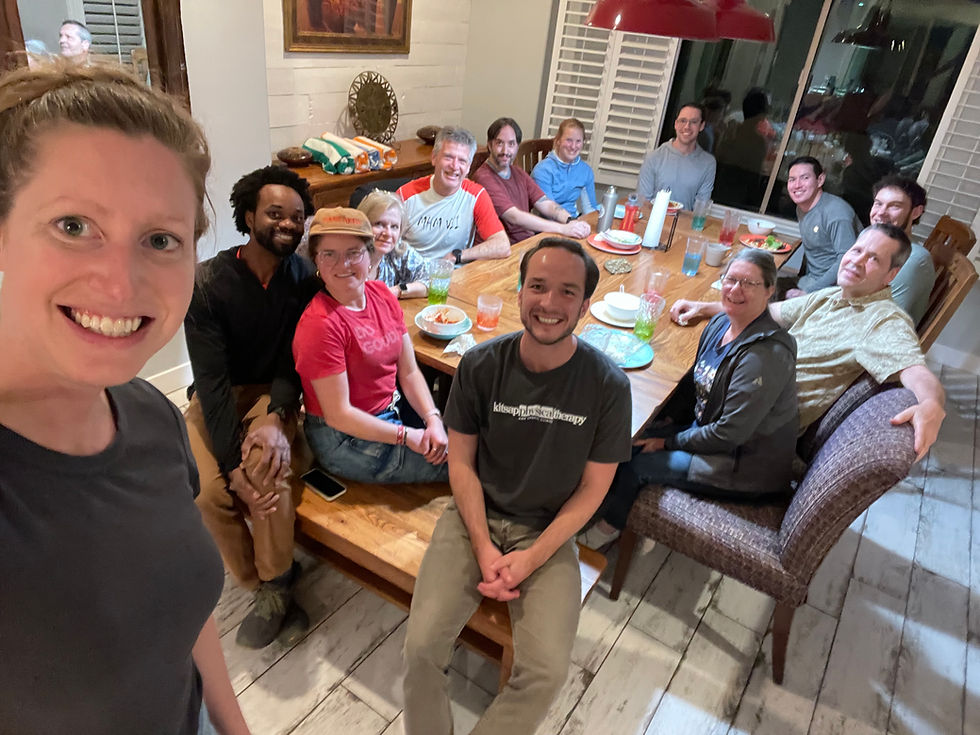
Here's the whole crew enjoying dinner in our 'BnB before the race!


Comments